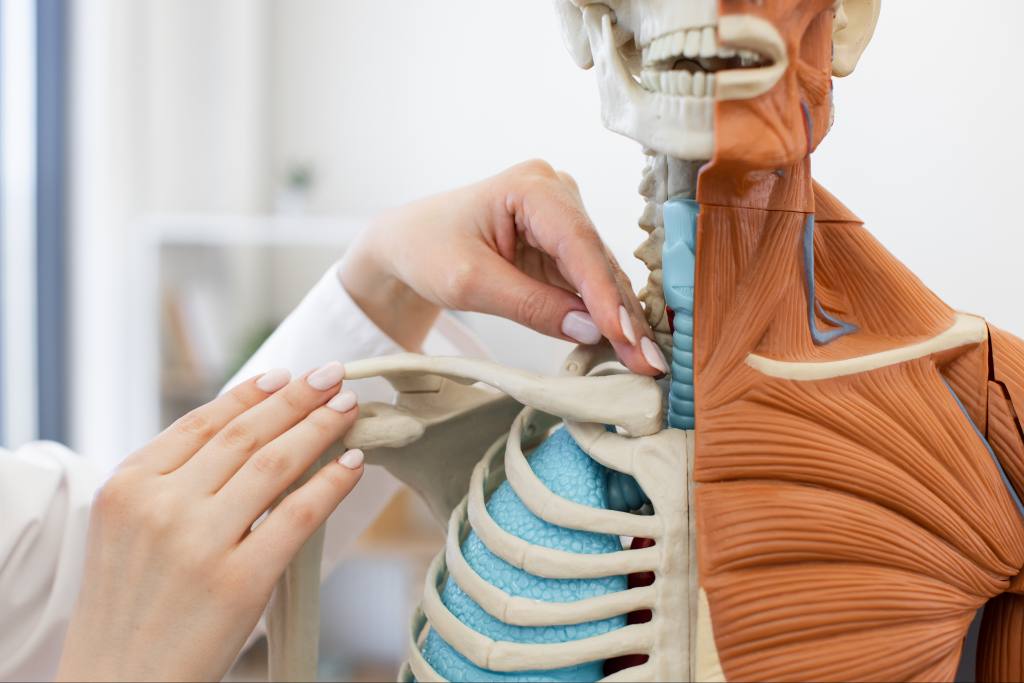


Thoracic outlet syndrome is compression of the nerves and blood vessels that pass through the narrow space between your collarbone and your first rib. The giveaway is position. Symptoms arrive when the arm goes overhead and settle when it comes down, which is the reason reaching for a high shelf or blow-drying your hair sets it off.
No scan confirms the common form of it. A thoracic outlet syndrome test works by narrowing that space on purpose to see whether your symptoms come back, and reading those tests correctly is most of the diagnosis.
What Is Thoracic Outlet Syndrome?
Thoracic outlet syndrome is a group of conditions caused by pressure on the nerves or blood vessels that run from your neck into your arm. The thoracic outlet is the space they pass through, sitting between your collarbone and your first rib and continuing under the pectoralis minor muscle at the front of the shoulder. Three structures share that space: the brachial plexus, which carries every nerve signal to your arm and hand, and the subclavian artery and vein, which carry blood to and from the arm.
The space is narrow to begin with, and certain positions make it narrower. Raising your arm overhead closes the gap between the collarbone and the first rib. Rolling the shoulders forward does the same. When any of the three structures gets squeezed in one of those positions, you feel the symptoms described above: numbness, tingling, heaviness, or a change in color or temperature in the hand. Bring the arm back down and the pressure eases, which is the reason so many patients are told for years that nothing is wrong.
The structure being compressed decides what the condition looks like and how urgently it needs attention. Pressure on the nerves produces the numbness and weakness that make up the vast majority of cases. Pressure on the vein or artery is far less common and shows up as swelling, discoloration, or a cold, pale hand.
Types of Thoracic Outlet Syndrome
Neurogenic Thoracic Outlet Syndrome
Neurogenic thoracic outlet syndrome accounts for well over 90 percent of cases. Here the brachial plexus takes the pressure, and the symptoms are nerve symptoms: numbness, tingling, weakness, and a heavy aching arm that worsens when elevated.
Compression falls on the lower part of the plexus most often. Symptoms land in the ring and little fingers, running along the inside of the forearm. Grip weakness and dropping things follow in longer-standing cases.
Venous Thoracic Outlet Syndrome
Here the subclavian vein gets compressed, and blood struggles to leave the arm. The arm swells, turns bluish or purple, and feels tight and heavy. It sometimes arrives suddenly after heavy exertion, and it can involve a blood clot.
Arterial Thoracic Outlet Syndrome
The arterial type is the rarest of the three, at roughly one percent of cases. Compression falls on the subclavian artery, and the hand runs pale, cold, and weak, sometimes with a diminished pulse.
Both vascular types need urgent evaluation. A swollen, discolored arm or a cold, pale hand is not something to schedule around. Go to the emergency room, particularly if the swelling came on quickly.
What Causes Thoracic Outlet Syndrome
Anything that makes the outlet narrower than it already is can bring on symptoms. Some causes build slowly through daily habits and work, some arrive with an injury, and some are part of the anatomy you were born with. Most patients have more than one.
Everyday Loading
Posture. Rounded shoulders and a head carried forward narrow the outlet and shorten the muscles crossing it. Desk work and phone use do this over years, and the resulting posture and neck strain sets up the compression long before symptoms start.
Repetitive overhead work. Painters, electricians, hairdressers, swimmers, and volleyball players spend hours in the position that closes the space.
Trauma. Whiplash and collarbone fractures both feature. A collision strains the scalene muscles that form the front wall of the outlet, and the scarring that follows narrows the outlet. We see this in accident patients whose neck settled down months ago and whose arm never did. Symptoms tend to appear months after the accident, long enough that people rarely connect the two.
Structural Causes
Anatomy you were born with. An extra cervical rib, a fibrous band, or an unusually shaped first rib narrows the outlet from the start. Plenty of people carry one and never develop symptoms until something else, posture or an injury, tips the balance.
Weight and pregnancy. Both shift how the shoulder girdle sits, and both can bring on symptoms that resolve as the underlying situation changes.
Thoracic Outlet Syndrome Symptoms
Thoracic outlet syndrome symptoms track with where your arm is:
- Numbness or tingling in the fingers, often the ring and little finger
- Aching or heaviness in the arm that builds with overhead activity
- Weakness in the hand, with a grip that fails without warning
- Pain across the neck, shoulder, and upper chest
- Symptoms that wake you when you sleep with the arm raised
- A cold or discolored hand, which points toward the vascular types
- Arm swelling, which does the same
Symptoms usually stay on one side. They build over months instead of arriving overnight, and they tend to follow a job or a sport that keeps the arms up.
Because the numbness and heaviness travel down the whole limb, thoracic outlet syndrome is easy to mistake for other causes of upper arm pain, from a strained biceps to a pinched nerve in the neck. The position link is what separates it. Muscle and joint problems hurt with use in any position, while the outlet only complains when the arm is up.
How a Thoracic Outlet Syndrome Test Works
There is no single scan that confirms neurogenic thoracic outlet syndrome. Diagnosis leans on provocative maneuvers, which put the arm in positions that narrow the outlet to see whether your symptoms reappear.
Roos Test, Also Called EAST
You raise both arms into a “stick ’em up” position, elbows bent to ninety degrees, and open and close your hands slowly for three minutes. A positive result means your usual symptoms return before the time is up, or your arms get too heavy and tired to finish.
The Roos test carries the most weight for the neurogenic type, because it loads the nerves in the exact position that provokes them in daily life.
Adson’s Test
Your examiner finds your radial pulse, then has you extend your neck, turn your head toward the affected side, and hold a deep breath. A change in the pulse or a return of symptoms counts as positive.
Adson’s has lost standing over the years. Vascular surgery literature now describes the pulse-based version as having little clinical value, because the pulse fades in plenty of people with nothing wrong with them.
Wright’s Hyperabduction Test
Your arm gets raised and rotated outward while the pulse is monitored. It targets compression under the pectoralis minor instead of at the collarbone.
A fourth maneuver, the upper limb tension test, stretches the arm and wrist away from the body to put the nerves under tension along their full length. It is often run alongside Roos to see whether the nerve, not the pulse, is what reacts.
How Thoracic Outlet Syndrome Is Diagnosed
A positive maneuver raises suspicion. It does not settle the question, because these tests also come back positive in roughly one in ten people with no symptoms at all. When the standard is whether your symptoms return, the tests are even easier to trip in healthy people.
Running several maneuvers together fixes most of that. A provider who sees the same symptoms reproduced across two or three positions has a far more reliable finding than one test in isolation. The condition can be identified with confidence. One test in a video is not how it gets done.
Ruling things out is the other half of the exam. Nerve conduction studies, cervical spine imaging, and vascular studies each exclude something different. A cervical rib or an extra fibrous band turns up on X-ray in a minority of cases. At AICA Atlanta the imaging happens in the same building as the exam, and the ruling-out does not stretch across three appointments.
Thoracic Outlet Syndrome vs Carpal Tunnel and Cervical Radiculopathy
Two conditions produce nearly identical hand symptoms.
| Thoracic outlet syndrome | Carpal tunnel | Cervical radiculopathy | |
| Fingers affected | Ring and little finger | Thumb, index, middle | Depends on the level |
| Worse with | Arms overhead | Wrist flexion, gripping | Neck extension and rotation |
| Better with | Arms down and supported | Shaking the hand out | Arm raised above the head |
| Neck involvement | Common | None | Central |
The clearest dividing line is the little finger. Carpal tunnel syndrome compresses the median nerve at the wrist and spares it entirely. Cervical radiculopathy compresses a nerve root at the neck, and lifting the arm to rest a hand above the head typically relieves it. The same position makes thoracic outlet symptoms worse.
They can also coexist. A nerve compressed in two places along its length hurts more than one compressed in either place alone, and treating only the obvious site leaves you half better. Thoracic outlet syndrome sits alongside carpal tunnel and sciatica among the nerve-compression conditions we treat, and the exam has to find every point along the nerve where the pressure sits.
Thoracic Outlet Syndrome Exercises and Treatment
Non-surgical treatment comes first, and it settles most neurogenic cases.
Manual Therapy and Chiropractic Care
Manual therapy releases the scalene muscles along the side of the neck and the pectoralis minor beneath the collarbone, the two structures that most often narrow the outlet. Chiropractic adjustment restores movement to the upper ribs and the cervical and thoracic segments that have stiffened. Your chiropractor handles the joint restriction and your physical therapist handles the muscle length, both working from one plan instead of two. Together they give the nerves and vessels more room.
Thoracic Outlet Syndrome Exercises
The exercise program has three jobs. Postural retraining pulls the shoulders back off the outlet. Strengthening the muscles that hold the shoulder blade in position keeps them there. Nerve glides encourage the brachial plexus to move freely through the space instead of catching.
Progression matters more here than intensity, since pushing too hard too early flares the symptoms. Related shoulder pain often improves alongside, because the same postural fault feeds both.
When Conservative Care Is Not Enough
Surgery, usually first rib resection with release of the scalene muscles, is reserved for cases that fail months of good rehab and for the vascular types, which frequently need earlier intervention. The large majority of neurogenic patients never get there.
Get Your Arm Back at AICA Atlanta
If your hand goes numb every time you wash your hair or reach for a top shelf, you have probably been living around it for a while. Maybe you were checked for carpal tunnel, given a wrist brace, and sent home no better. Numbness that follows arm position has a mechanical cause, and it can be found and treated. At AICA Atlanta, the exam that tests those positions, the imaging that rules out the look-alikes, and the treatment itself all happen in the same clinic. Your chiropractor and physical therapist work from one plan to open the space behind your collarbone and keep it open, and you are not sent across town to piece the answer together. Same-day appointments are available and the consultation is free. Call 404.889.8828, schedule online, or find the nearest AICA location and let us find out why your arm goes numb.
Frequently Asked Questions
What does a positive thoracic outlet syndrome test mean?
Your symptoms were reproduced when the outlet was narrowed, which raises suspicion without confirming anything. Healthy people test positive at a meaningful rate, and providers run several maneuvers together and read them alongside your history and other testing.
Can thoracic outlet syndrome go away on its own?
Cases tied to posture or a temporary change in activity tend to settle once the aggravating position stops. Cases driven by an anatomical narrowing or scarring after an injury generally need treatment, and the vascular types need it promptly.
How long does treatment take?
Conservative care runs several months for the neurogenic type. Improvement tends to be gradual, with overhead tolerance returning before the numbness fully resolves.
Is thoracic outlet syndrome the same as a pinched nerve?
It is a form of nerve compression, though the location sets it apart. Compression happens between the collarbone and first rib, not at a spinal nerve root or in the wrist. That difference changes both the testing and the treatment.
Should I stop exercising?
Not entirely. Anything that parks the arms above shoulder height will aggravate it, including overhead lifts and carrying heavy bags by the strap. Walking, lower-body training, and the prescribed rehab work all help. An exam should set the boundaries, since which movements provoke your symptoms depends on where the compression sits.